
 |
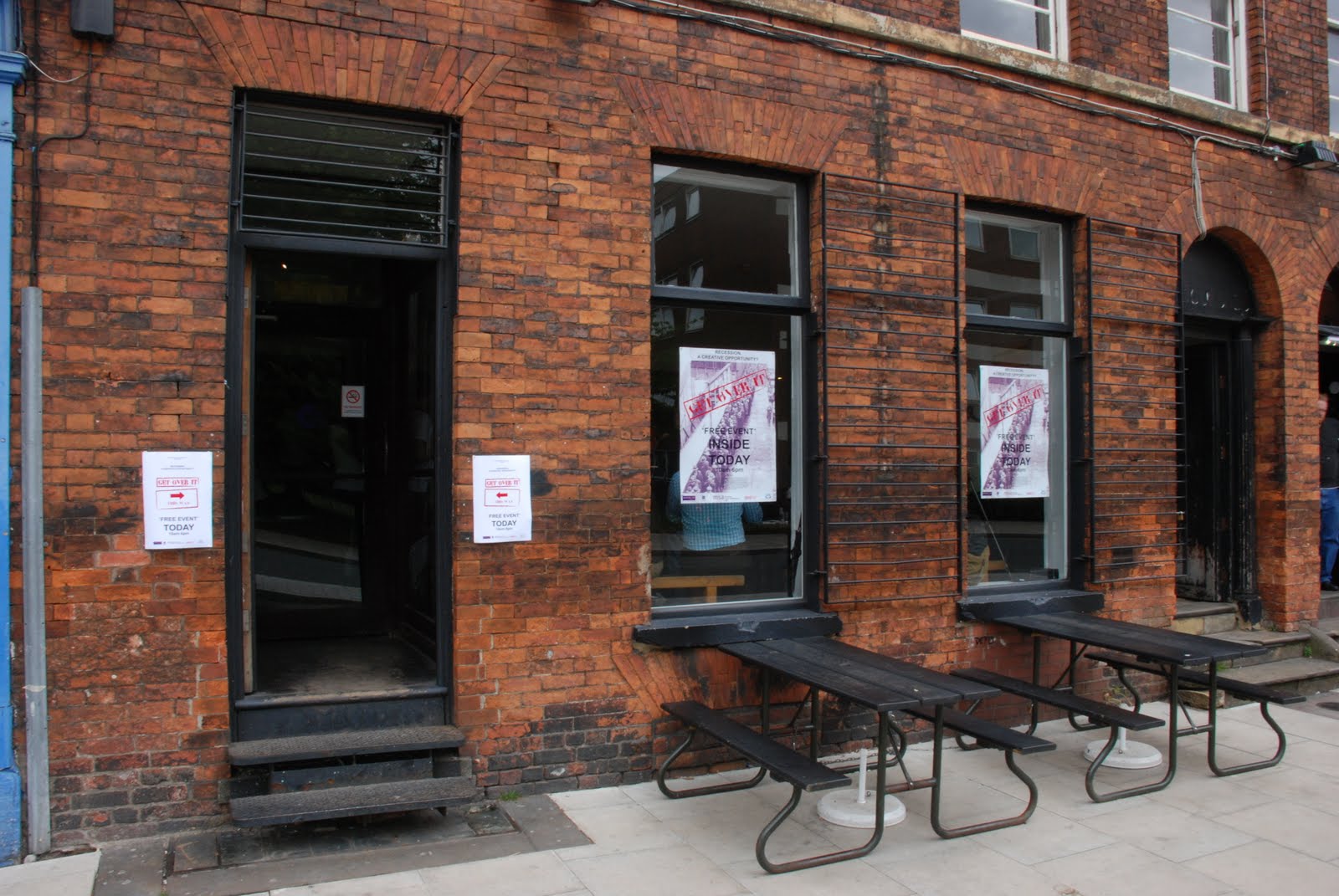
| Sand Bar ready to Get Over It! |
The second of these annual symposia was held on 12 May at sandbar in Manchester, a well known gathering place for academics and ‘creatives’, the use of which was kindly donated by MA A+U student Stephen Gingell.
 |
| The event kicks off. |
Author and journalist Owen Hatherley chaired the event and began the day with an outline of the social and economic context of the last few years, including the well-documented regeneration efforts in Manchester.
 |
| A packed house. |
The first speaker was Dr. Mark Jayne, an urban geographer at the University of Manchester. Appropriately enough given the venue, Mark's presentation explored the relationship between drink and British urban life, representing what is often portrayed by the media to be a problematic activity instead as one through which life is enjoyed as a communal activity in the public sphere.
 |
| Gallows humour in Mark Lemanski's presentation. |
The second presentation of the day was by Mark Lemanski of muf architects who discussed a number of the practice’s public realm projects in London including their award-winning Barking Town Square. He gave particular attention to the opportunities available to architects through engagement with local communities but also stressed that with these opportunities came particular responsibilities. With a certain amount of gallows humour, comic interventions from George Osborne were introduced into the presentation to highlight the difficulties creative groups face in providing anything for the communities that they seek to serve.
 |
| Mark Lemanski and Owen Hatherley field questions from the floor. |
A brief debate with interventions from the floor preceded lunch. Hatherley and Lemanski fielded questions from the audience, covering the place of branding in design, nostalgia, localism, self-censorship by architects and how they can challenge stereotypes and perceptions of public space.
 |
| Rose Marley talks about The Sharp Project. |
After lunch Rose Marley spoke about The Sharp Project in Manchester, a large scale digital facility intended both to help regenerate New East Manchester and provide for the creative digital industry in the wider city. Rose claimed the creatives view that “there are always opportunities in difficult situations” and The Sharp Project’s “geekonomics” approach provided the right environment. This presentation raised the issue of new educational and employment patterns, which would create profound change in the life prospects of some of Manchester's most marginalised citizens.
 |
| Geoff Denton explains the Salford House 4 Life Project. |
Mid afternoon was anchored by Geoff Denton of Stockholm-based White Architects who talked about their competition-winning project for Salford House 4 Life. Against the trend of anonymous apartment blocks the project proposes low-rise, robust family housing around communal spaces which offer a utopian prospect for future urban wellbeing. The project is an explicit rejection of greedy economic housing models visible on adjacent sites where new forms of anti social behaviour have already been fostered. He stressed the importance of context in the use of materials, the longevity of the typology and the sustainability of the lifestyle in a non-precious framework.
 |
| Elizabeth Varley shortly before her presentation |
The day was concluded by Elizabeth Varley from techhub an enterprise at the heart of 'Silicon Roundabout' who emphasised the global potential of the digital economy in turning the urban situation around. She discussed the importance of collaborative spaces and the need for openness in future, flexible, work environments. Social networking, viewed as a facilitator and enabler by Varley, will be very important if companies are to embrace “openness and collaboration”.
The day brought together an eclectic and apparently random mix of people but out of that shared experience and brainstorming new connections were forged. It provided a potential point of departure for new research ideas about the city. As Mark Lemanski pointed out, while ‘pop-ups’ do provide encouragement, the temporary uses that have filled the debate in recent years offer only limited potential to overturn the situation long term. At this point in the economic cycle when London is already picking up where it left off in 2007 Manchester continues to be open for a variety of innovative possibilities. Despite the economic power of the south east this event proved that regional centres have a great deal of expertise to offer in the field of creative regeneration … so … GET OVER IT!
MA A+U Students 2011
Luke Butcher, Jack O’Reilly, Matthew Pilling, Preeya Vadgama, Supriya Pundlik,Ketki Tendolkar, Angad Kasliwal, Natalie MacBride, Christina Gregoriou, Meliz Kusadali, Charlotte Gildart-Butler, Rongxiao Han, Laleh M.Fadaipour, Chen Xu, Carrie Bayley, Kathryn Timmins, Stephen Gingell, Jonas Komka, Anastassia Kolpakova, Angela Heaney, Rob Aspray
 |
| MA A+U Students 2010-2011 ... Get Over It! |


